OpponentBook Review: Opponent Notes for Combat & Racket Sports
OpponentBook review: an opponent and training journal for fencing, judo, BJJ, boxing and racket sports. What's free, what Pro adds, who should skip it.
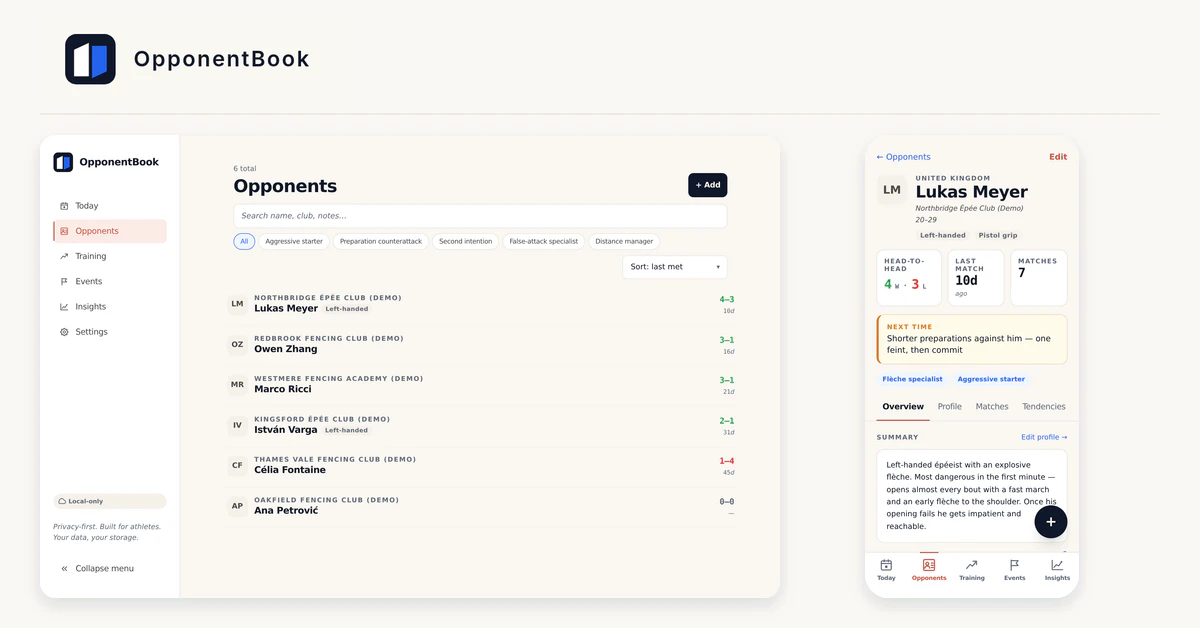
OpponentBook is a journaling app for competitive athletes in individual sports — fencing, tennis, judo, boxing and twelve others. Instead of dated diary entries, it organises your writing around the people you compete against: one page per opponent, with your match history and reflections attached. The free tier is the whole journal — unlimited opponents, matches and media — and your notes live on your own Google Drive, Dropbox or iCloud rather than the company’s servers.
It is the most focused niche journaling app we have covered, with one of the most privacy-conscious designs in the category. It is also genuinely niche: if you don’t compete, it is not for you; the paid tiers come with no trial and no refunds; and the native mobile apps have not shipped yet.
Verdict at a Glance
✅ Worth trying if
You compete in an individual sport and want one private place for opponent notes, match reflections and training — with a free tier that is actually complete.
⛔ Skip it if
You want a general-purpose diary, play a team sport, or expect native mobile apps today, wearable integrations, or open-source code.
Jump to: Sports · Training · Free tier · The analysis · Privacy · Limitations
What is OpponentBook?
If you compete seriously in a combat or one-to-one sport, you keep meeting the same people. The opponent who beat you in February will be across the piste, mat or net again in October — and what you learned in that match is either written down somewhere, or quietly fading and distorting in your memory.
OpponentBook launched in 2026 to give that knowledge a permanent, private home. The whole app is built around one habit: after every match, you write down what happened against that specific opponent.
Each opponent gets a page — profile, style tags, match history, free-form notes, photos and video. Each match gets a structured reflection: what worked, what didn’t, what to remember next time. A separate training journal covers what you did between competitions.
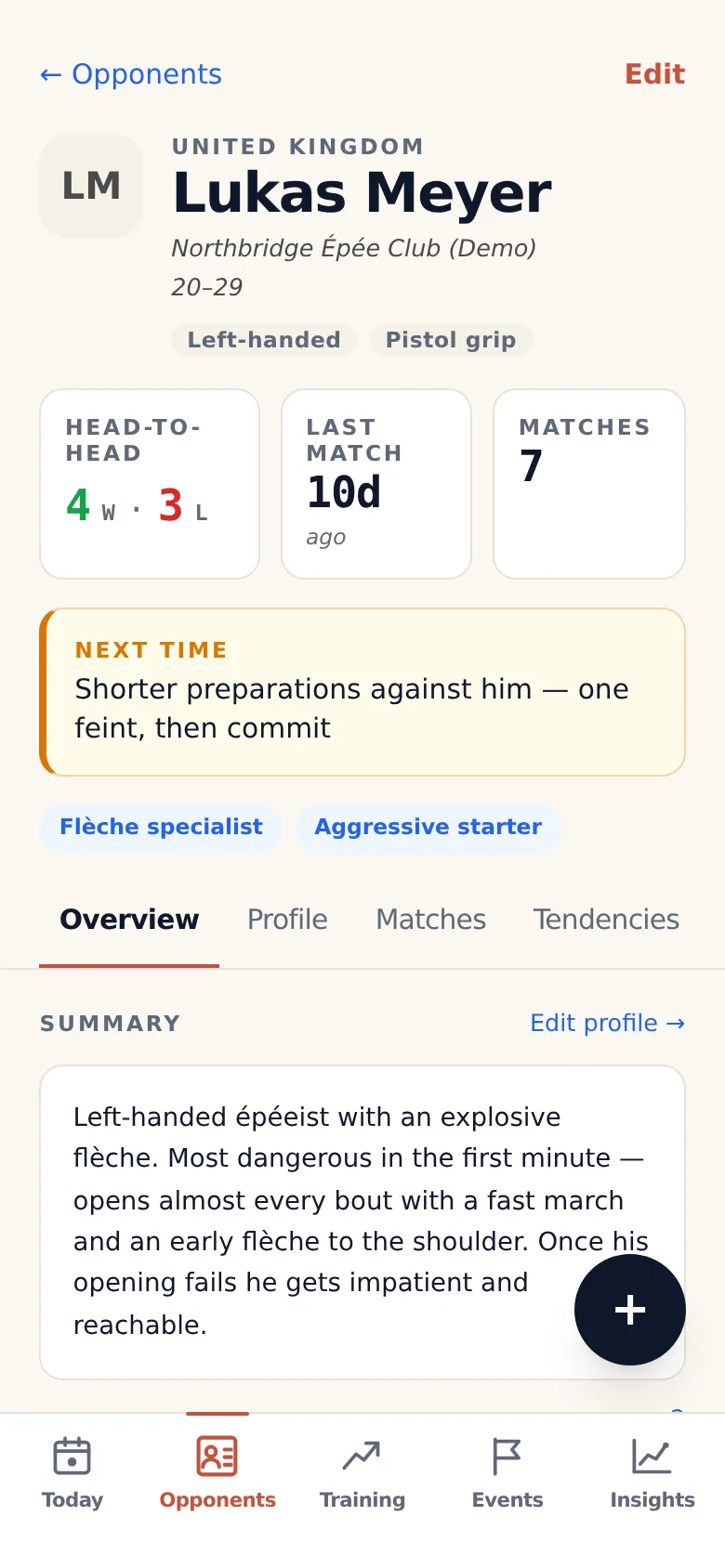
Most of the value sits in the writing itself, not the software. Turning a vague post-match impression into your own words — “don’t open long in the first three touches, she reads it” — is what turns a feeling into a tactical plan you can actually rehearse. The app’s structure exists to get that sentence written, and to put it back in front of you before you face the same opponent again.
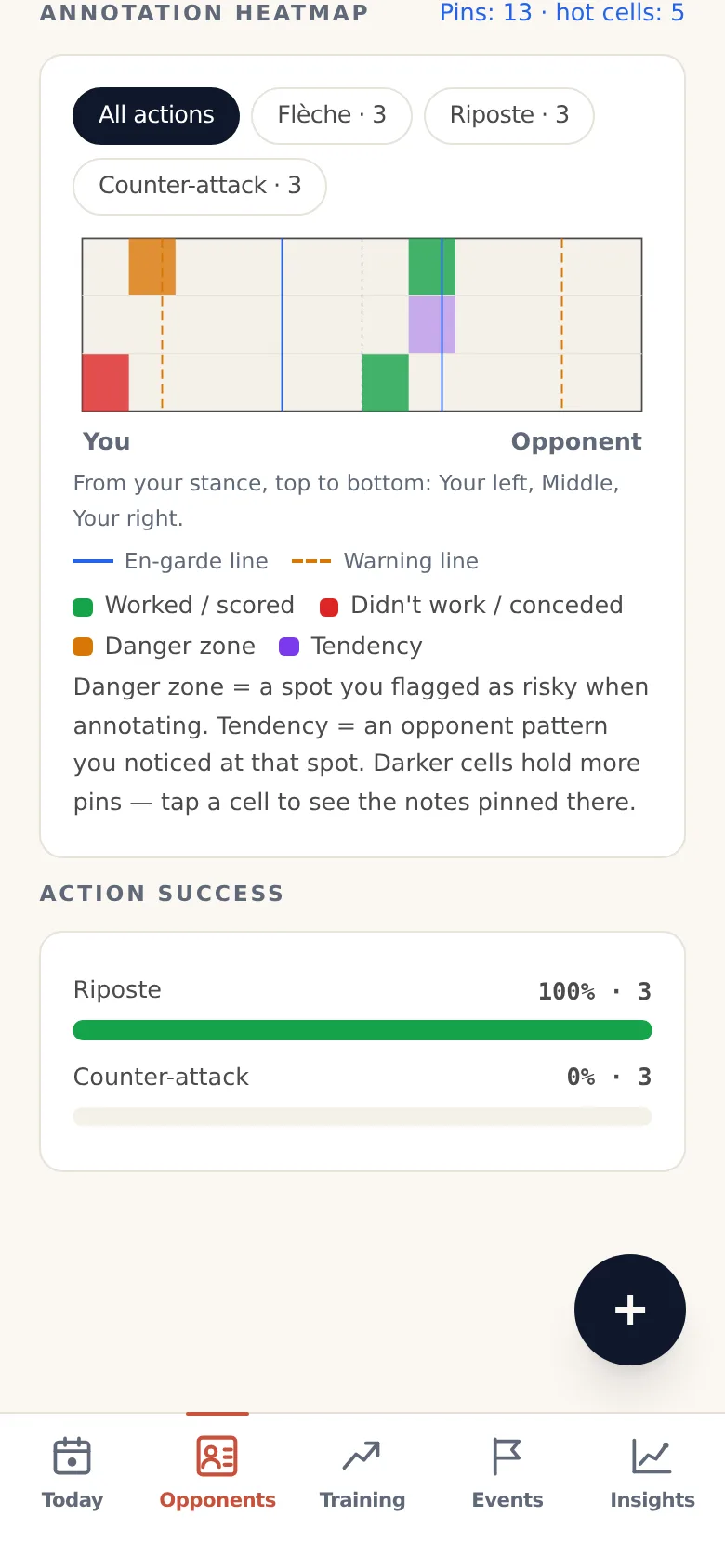
The signature feature is spatial annotation. You drop pins on a drawing of your sport’s playing surface — a fencing piste, a table-tennis table, a boxing ring — to mark where points happened or where an opponent is dangerous. Grappling sports like BJJ use positions (guard, mount, back) instead of a map.
Pin enough matches and, on Premium, the pins aggregate into a heatmap: green cells where your actions worked, red where they didn’t, plus zones you flagged as dangerous and patterns you noticed. Alongside it sits an action-success breakdown — how often your riposte, your counter-attack or your flèche actually scored against that person.
The design is deliberately quiet. There are no streaks, badges or points — an unusual choice in this market, and our piece on journaling streaks looks at what streak mechanics do to a writing habit.
There is some evidence behind the underlying habit. An older but frequently cited 2009 study led by Tynke Toering at the University of Groningen, published in the Journal of Sports Sciences, compared elite and non-elite youth footballers and found that reflection was among the self-regulation skills most strongly associated with playing at the elite level.
That is an association in one sport, not proof that an app improves results. But it does suggest the post-match debrief OpponentBook is built around is not an arbitrary ritual.
How much does the app actually know about your sport?
Sixteen individual sports are supported: fencing, tennis, table tennis, badminton, padel, squash, judo, BJJ, wrestling, kendo, boxing, MMA, taekwondo, karate, kyokushin and ju-jitsu. Team sports are deliberately out of scope.
Every sport gets the same three things: a schematic to pin annotations on, a set of opponent profile fields, and its own tag vocabulary.
The schematic is where they genuinely diverge. Striking and racket sports get a map of the playing surface — a piste, a court, a table, a ring — and you pin where actions happened.
Grappling sports work from positions instead, because where you were on the mat matters far less than whether you were in guard, in mount or on the back.
The depth is not evenly distributed, and that is our main reservation about the sixteen-sport claim.
Fencing is plainly where the app is deepest. It gets a sudden-death priority statistic free on every tier, fencing vocabulary runs through the action breakdowns, and every screenshot the company publishes is a fencing screenshot.
For the other fifteen, the vendor’s per-sport help pages confirm that a schematic, structured fields and a tag taxonomy exist — but never say which positions, fields or statistics each sport actually gets. We compared four of those pages and they are the same page with the sport name substituted in.
So a wrestler or a padel player cannot tell from the documentation how well their sport is modelled without signing up and looking. That is not evidence the other sports are served badly; it is a gap in what can be verified from outside, and we would rather say so than imply we tested sixteen sports.
If you compete in anything but fencing, treat the free tier as the way to find out. That is exactly what it is good for.
What about the training between competitions?
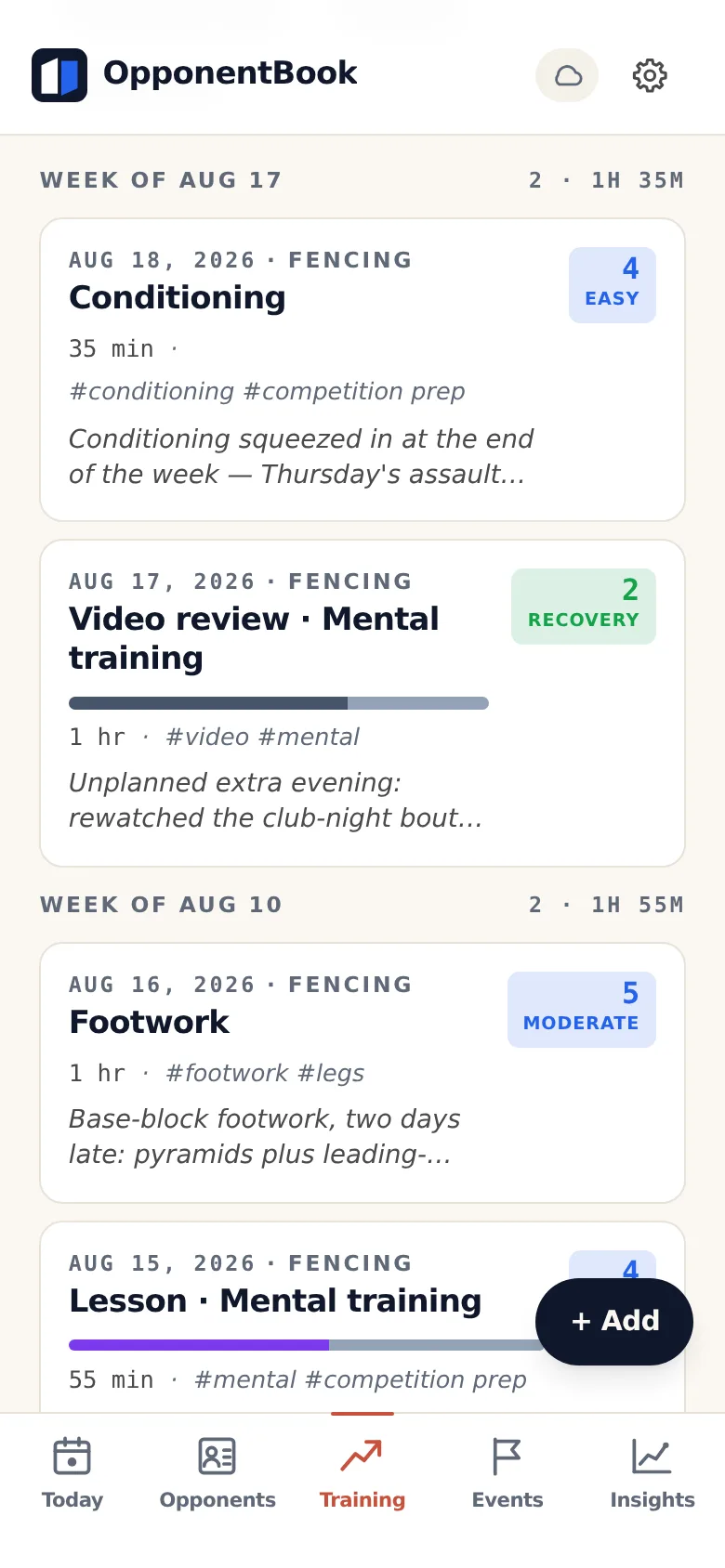
Matches are a handful of days a year; training is the rest of it. OpponentBook keeps a second, separate stream for that — a training journal where each session gets a date, a category, a duration, a perceived-effort rating, free-form notes and tags.
It is deliberately spare. There is no exercise library, no wearable import, no GPS or heart-rate data. What you get is a readable week-by-week record of what you actually did and how hard it felt.
That effort rating is the part worth using properly. A 2016 systematic review by Anna Saw, Luana Main and Paul Gastin at Deakin University, published in the British Journal of Sports Medicine, pooled 56 studies comparing subjective and objective monitoring and reported that self-reported measures tracked acute and chronic training load more sensitively than the objective markers they were compared against.
That review looked at structured wellbeing questionnaires rather than a single effort slider, so treat it as a reason to log the rating honestly rather than a promise about this app. It costs about ten seconds a session.
Training plans sit on Premium. You record the plan you intend to follow — a named date range with a weekly template of sessions, each with a category, an optional target duration and an optional note. Sessions can be pinned to a weekday (“footwork on Mondays”) or left day-flexible with a weekly count (“conditioning twice, any day”).
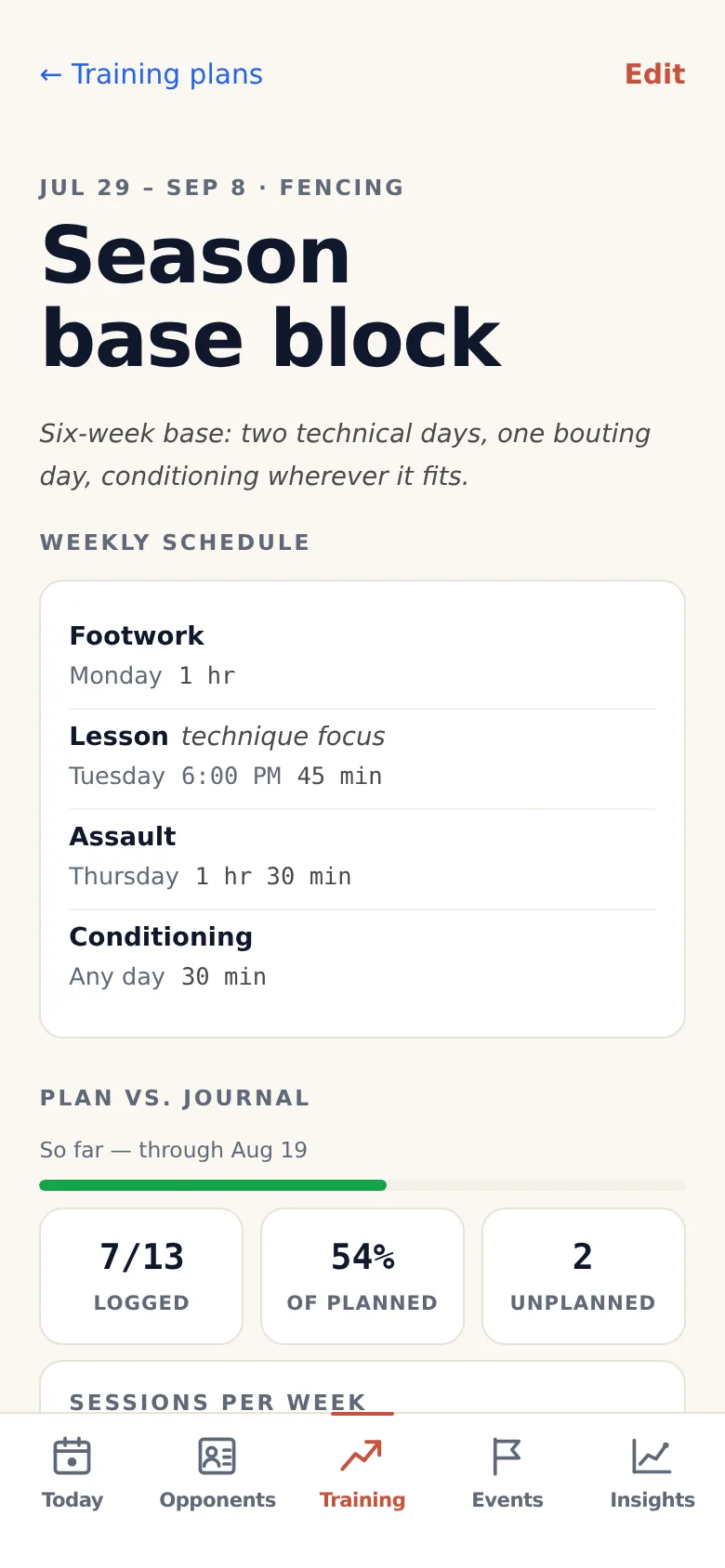
The useful half is the comparison underneath. Week by week, the app matches your logged sessions against the plan and shows what was done, what wasn’t, and what you did that the plan never asked for — the last one often being the most informative number on the screen.
Two design decisions deserve credit here. The comparison is descriptive rather than judgemental: no streaks, no score out of 100, no nudging you back into line. And the AI never writes or suggests a plan — you type in what your coach or your own planning produced, and the app only compares it against reality.
Plans are also portable in a way that fits how coaching actually works. A plan can be exported as a small file and sent to anyone, who imports their own independent copy — so a coach can write a block once and hand it round without anyone linking accounts.
A plan also exports as a standard .ics calendar file, so weekday-pinned sessions land in whatever calendar you already live in. Day-flexible sessions have no day to occupy, and the app says so rather than inventing one.
What do you get for free?
Almost everything. OpponentBook inverts the usual freemium formula: capacity is free, and the paid tiers sell analysis instead.
| ✅ Free tier includes | ⚠️ Watch out for |
|---|---|
| Unlimited opponents, matches and events | Sixteen supported sports — nothing for team-sport athletes |
| Unlimited photo and video, stored in your own cloud account | Storage limits are whatever your Google Drive, Dropbox or iCloud plan allows |
| Cross-device sync and a full offline mode | A note edited offline on two devices at once keeps one version, not a merge |
| PDF and Word export of any opponent or training subset | Free exports carry a small “Generated by OpponentBook” footer; Premium removes it |
| Training journal, search, tags, multi-sport rosters | Browser app only for now — native iOS and Android apps are still in development |
| Events, including tournament import from a calendar file | Training plans and the plan-vs-journal view need Premium |
| One-click JSON backup and restore | — |
One free feature deserves a closer look. The app records whether you opened an opponent’s notes before facing them, then shows the win-rate split between matches you prepared for and matches you didn’t.
On thin data it shows a “need more data” card rather than inventing a trend, and the company’s help pages state that the tracking can be switched off, its history erased, and that the events live in your own storage. Treat the split as a nudge rather than proof — you probably prepare hardest for the matches you already care most about.
What do Premium, Pro and Max actually add?
The paid tiers gate intelligence, not capacity. The pricing page is explicit that nothing you write is ever locked behind a subscription.
| Tier | Monthly | Annual | What it adds |
|---|---|---|---|
| Free | $0 | $0 | The complete journal: unlimited entries, media, sync, export |
| Premium | $9.99 | $99 | Analytics dashboard, aggregated heatmaps, training plans, AI opponent summaries, voice dictation, branding-free exports |
| Pro | $19.99 | $199 | Cross-corpus AI: style archetypes, weakness analysis, evolution over seasons, pre-competition briefs, in-depth match reviews |
| Max | $39.99 | $399 | Same features as Pro with roughly double the monthly AI caps |
The AI additions at Premium are small and scoped: a one-tap summary of your own notes on one opponent, tag and profile-field suggestions, and dictation into any text field so you can talk a debrief in on the drive home.
What do the statistics actually tell an athlete?
Premium’s dashboard is plain descriptive statistics, and the splits are where it earns its money. Your record against the style tags you attach to opponents — preparation counter-attackers, distance managers, flèche specialists — turns a vague sense of “I struggle with those” into a number with a sample size next to it.
The same screen carries results by venue type and time of day, win/loss trends across the season, and the aggregated heatmaps: across every bout with one opponent, or every opponent sharing a tag, where do you score and where do they score on you?
Fencers get one more statistic free on every tier, and it is a revealing one. Bouts that reach the sudden-death priority minute are split by whether you or the opponent held priority — a direct read on whether you can close out the tightest bouts of a season, or only win them when the coin lands your way.
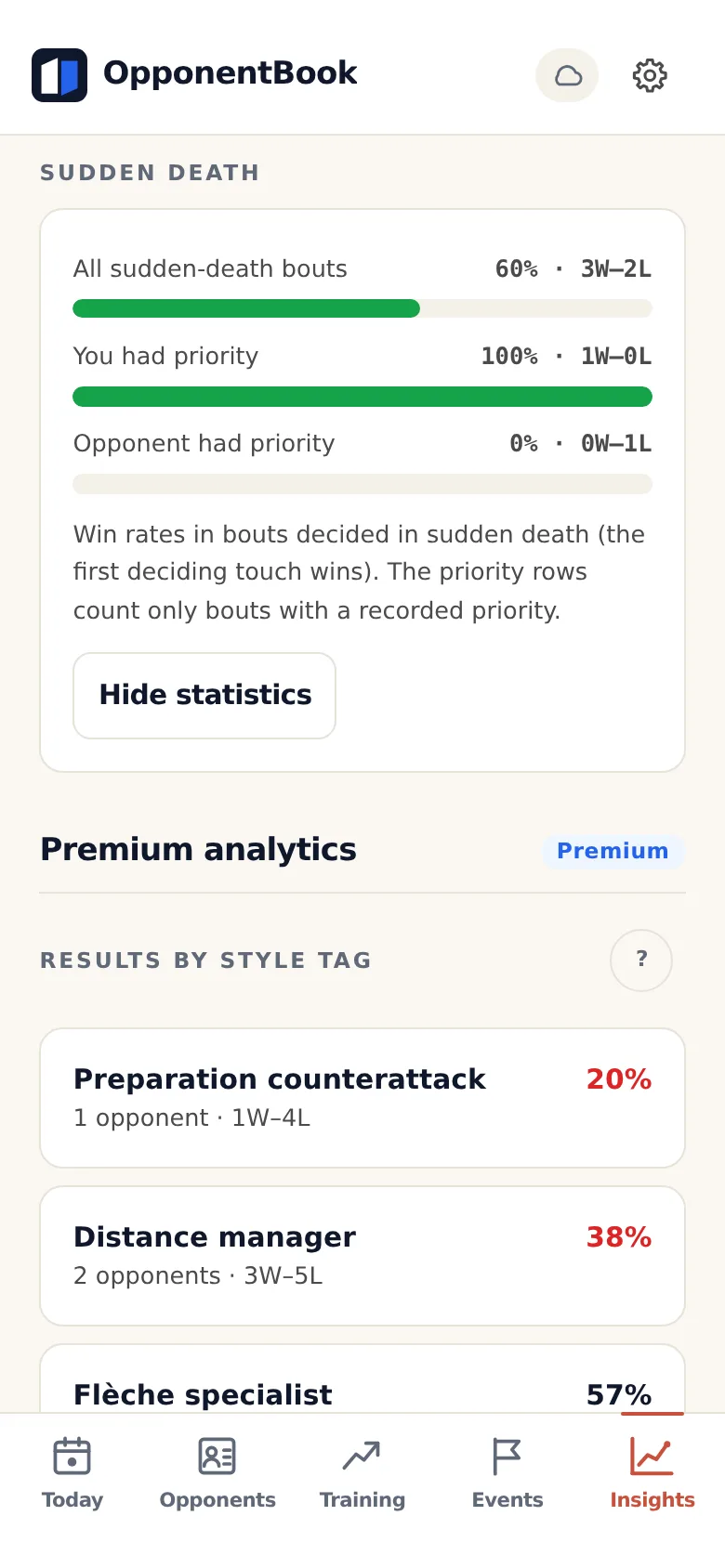
Every number on that screen is computed from your own logged matches on your own device — there is no benchmark against other athletes, because the app has no other athletes to look at.
And the AI analysis on Pro?
Pro reads your whole opponent book for the sport you are currently competing in and looks for patterns across it, rather than summarising one match at a time.
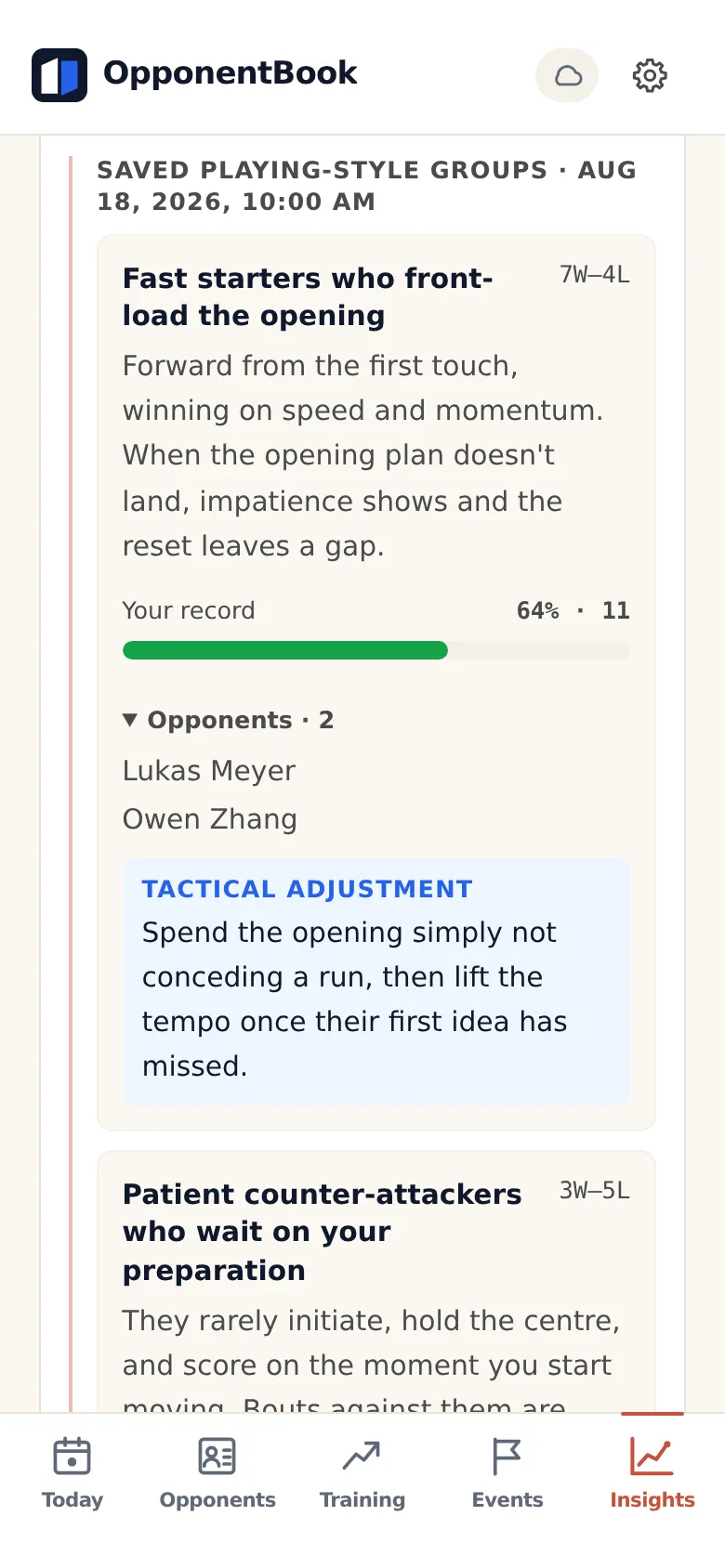
Style archetypes group the opponents you face into recognisable types, then attach your actual record against each group and one tactical adjustment. It is the analysis that most directly answers “what kind of fencer, grappler or player keeps beating me, and what should I do differently?”
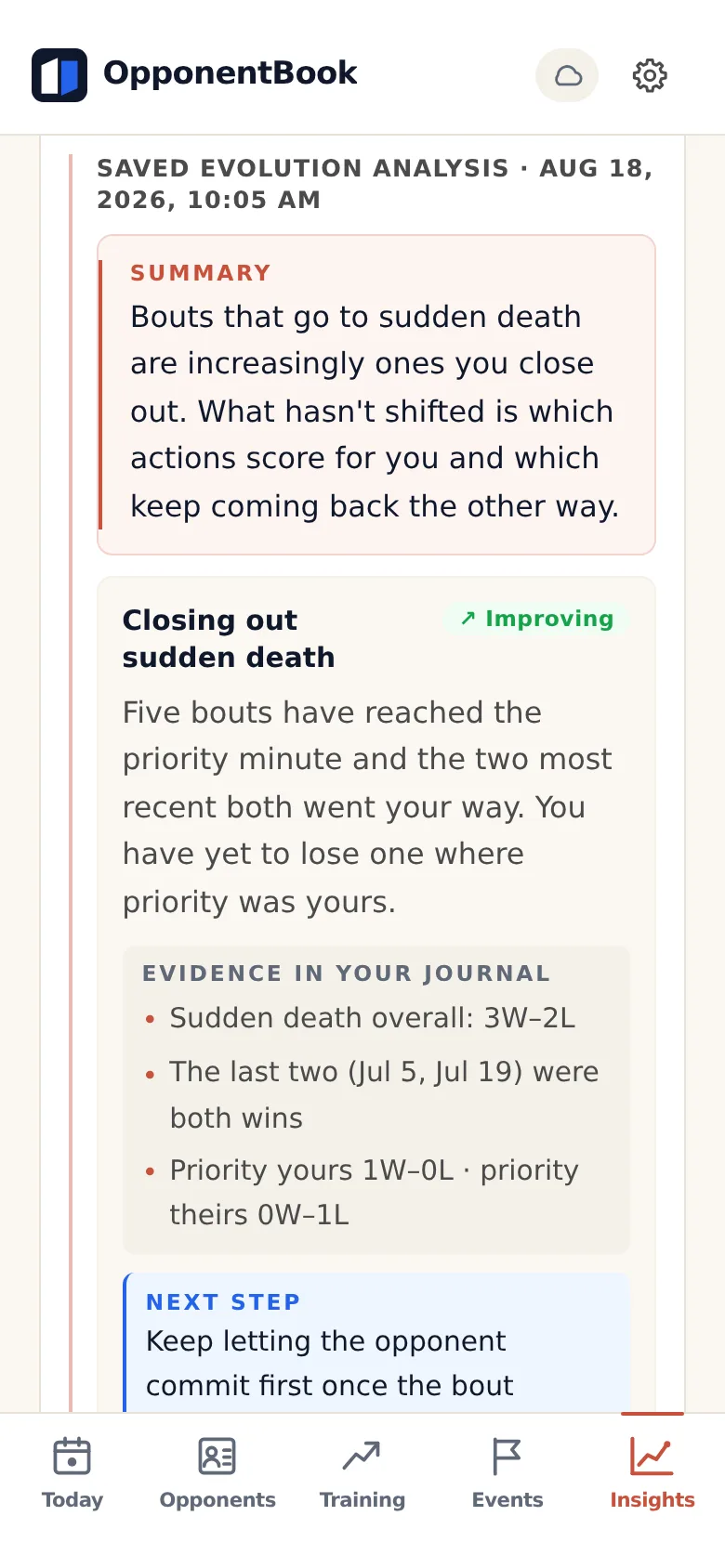
Evolution analysis does the same job across time instead of across opponents: what has changed over the past season, what has not, each claim carrying dated evidence from your own journal rather than an assertion.
Personal weakness identification works one opponent at a time, examining both what repeatedly succeeds and what repeatedly fails against them — it is required to look at your wins as hard as your losses.
In-depth match reviews expand a single bout into several hundred words of reasoned analysis, and training-note themes read back over your recent training entries to surface what you have been telling yourself without noticing.
The one athletes will use most often is the pre-competition brief: a short read for the minutes before you step on, with one line per likely opponent, the themes that connect several of them, and a single reminder for yourself.
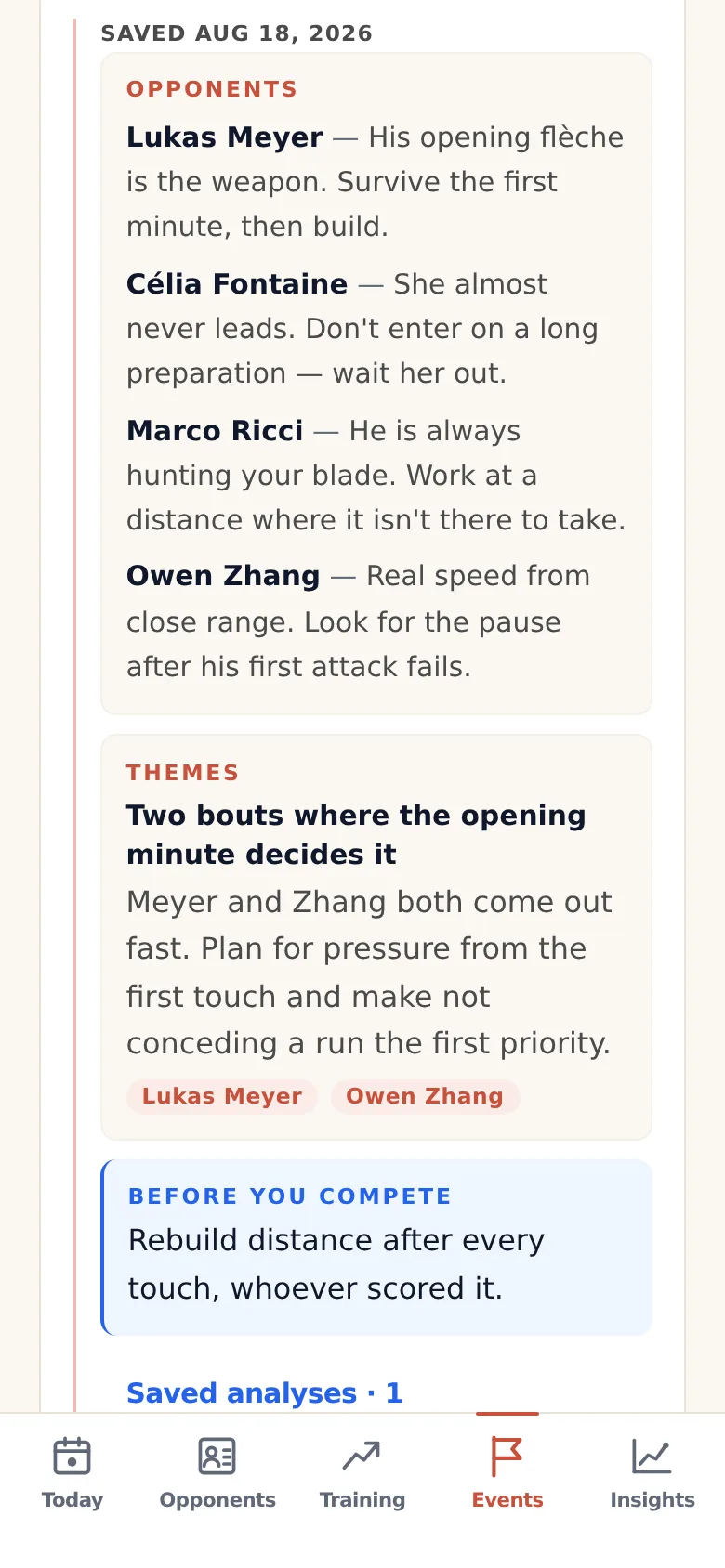
Two caveats matter more than any of the features. All of this is generated from your own notes, and the documentation is explicit that thin data produces a refusal rather than invented insight.
The statistics are similarly careful: the prepared-versus-not win rate stays hidden until both sides of the split reach ten matches, and elsewhere every figure carries the sample size it was computed from.
And the AI is kept firmly on the analysis side of the line: it never writes your training plan and never issues generic coaching advice. Every AI feature has a visible monthly cap, and saved analyses are written to your own storage, where they stay readable even if you cancel.
One commercial detail to weigh before paying: there is no free trial and no refunds — the company’s position is that the free tier is the trial. Since the AI analysis is the whole reason to pay, you are buying your first month of Pro on trust.
How private is OpponentBook really?
Opponent notes are candid by nature — they are your unfiltered read on real, named people you will face again. OpponentBook’s answer is architectural: your content is written to storage you already own, and the company’s servers keep only your login, subscription state and a content-free skeleton of IDs and dates.
The privacy claim is structural rather than promissory: the company cannot read notes it never stores.
That framing matters, and OpponentBook’s own privacy explainer spells out the caveats itself. In standard mode your files sit on your cloud drive like any other file — readable, in principle, by Google, Dropbox or Apple.
Optional end-to-end encryption seals your written notes with AES-256-GCM on your device before upload, so your provider holds only ciphertext for the text. Photos and videos are not covered by that encryption — they sit on your drive as ordinary files in both modes.
The trade-offs are the ones that apply to every design of this kind, as we explain in our guide to journaling app privacy. Encryption is opt-in rather than the default — some journaling apps encrypt by default — and if you lose both your encryption password and the one-time recovery code, nobody can recover those notes.
The AI features have their own boundary worth knowing. Nothing is sent anywhere until you press an AI button; when you do, the relevant notes are sent to an external AI service for processing — a step outside the your-storage-only model.
If you never press an AI button, or flip the setting that disables AI entirely, no note content leaves your devices and your storage. Athletes who treat opponent notes as competitively sensitive may prefer it that way.
Before you keep reading
If the storage-you-own model interests you beyond sport, these cover it in depth:
Where does OpponentBook fall short?
It is niche by design. Sixteen individual sports, no team sports, and no plans to become a general diary. If you want one app for life journaling and match notes, this is two apps, not one.
It is new — and not fully shipped. OpponentBook launched in 2026 as a web app, and the native iOS and Android apps are still in development. There is no long track record to judge it by, and no way to know yet how well the product will be maintained.
No trial for the paid tiers. You cannot test Pro’s cross-corpus analysis before paying for a month of it, and refunds are explicitly not offered.
Closed source. OpponentBook’s code is proprietary, so the encryption implementation cannot be independently inspected. The architecture limits what the company could see, but you are trusting the implementation, and there is no published third-party audit.
Sharing is file-based. There is no shared coach account or linked squad view. You send a PDF, a Word document, a plan file or a calendar file instead — workable, and privacy-preserving by design, but every update means sending a fresh file.
AI means your notes travel. The optional AI features send the relevant notes off your storage for processing. If that is a line you don’t want crossed, the features have to stay switched off — and much of the paid tiers’ value goes with them.
Who should use it — and who should skip it?
Best for: athletes in the sixteen supported sports — fencers, grapplers, boxers, racket-sport players — who face the same names season after season, already scribble opponent notes into a phone notes app or a paper book, and want them organised, synced, exportable and private — at zero cost.
Skip if: you play a team sport, you want a journal for daily life rather than competition, you need audited or open-source encryption, you want a native mobile app today, or you expect training-load analytics with wearable data — OpponentBook has deliberately chosen not to build any of that.
Verdict
The Bottom Line
OpponentBook does one specific thing — a private, structured book on every opponent you face — that no general-purpose journaling app we have covered attempts, and it gives the core of that away free on storage you own. That earns it a real recommendation for competing athletes, tempered by its youth, its closed source, and its missing native apps.
The journaling market is crowded with general-purpose diaries and has remarkably little for the athlete who wants to remember how a specific left-hander beat them in February. OpponentBook fills that gap with restraint: no gamification, a storage model that keeps note content out of the company’s hands, and statistics that admit when the sample is too small.
Whether the paid AI analysis is worth $19.99 a month will depend on how much you compete and how much you write. The free tier asks for nothing, so that question can wait until you have a season of notes.
Frequently asked questions
Is OpponentBook free?
Yes. The free tier is the complete journal — unlimited opponents, matches, training entries, photos and video, cross-device sync, and PDF/Word export — with no time limit. Paid tiers add analytics, training plans and AI analysis, not capacity.
How much does OpponentBook cost?
Premium is $9.99/month, Pro is $19.99/month and Max is $39.99/month; annual plans are $99, $199 and $399 — roughly 17% cheaper. There is no free trial and no refunds, so test the free tier thoroughly first.
Can OpponentBook read your notes?
Not in normal use. Notes are written to your own Google Drive, Dropbox or iCloud; the company’s servers keep only your login, subscription state and a content-free skeleton of IDs and dates. If you use the optional AI features, the relevant notes are sent to an external AI service for processing.
What sports does OpponentBook support?
Sixteen individual sports — though the depth varies by sport: fencing, tennis, table tennis, badminton, padel, squash, judo, BJJ, wrestling, kendo, boxing, MMA, taekwondo, karate, kyokushin and ju-jitsu. Team sports are deliberately out of scope.
Is OpponentBook the same as OwnJournal?
No, they are different apps that share the same storage-you-own idea. OwnJournal is a general-purpose, open-source journal; OpponentBook is a closed-source journal built specifically around opponents, matches and training.
Does OpponentBook work on iPhone and Android?
In the browser, yes. OpponentBook runs as a web app on desktop and phones, works offline, and syncs through your own cloud storage. Native iOS and Android apps are in development but were not yet in the app stores as of August 2026; paid plans are sold through the website.
Try the habit before the app
You do not need OpponentBook to find out whether opponent journaling helps you — you need one honest entry. If you are new to reflective writing generally, our beginner’s guide to journaling covers the basics.
Start tonight: open whatever notes app you already have, write the name of the opponent who beat you most recently, and answer three questions — what worked, what didn’t, what will you try next time. If you find yourself doing that after your next three matches, you have the habit, and OpponentBook’s free tier is a natural place to keep it.