Journaling With ADHD: Practical Formats and Honest Evidence
No trial proves that journaling treats ADHD. This guide separates evidence on multicomponent ADHD care from low-friction writing ideas you can test for planning and reflection.
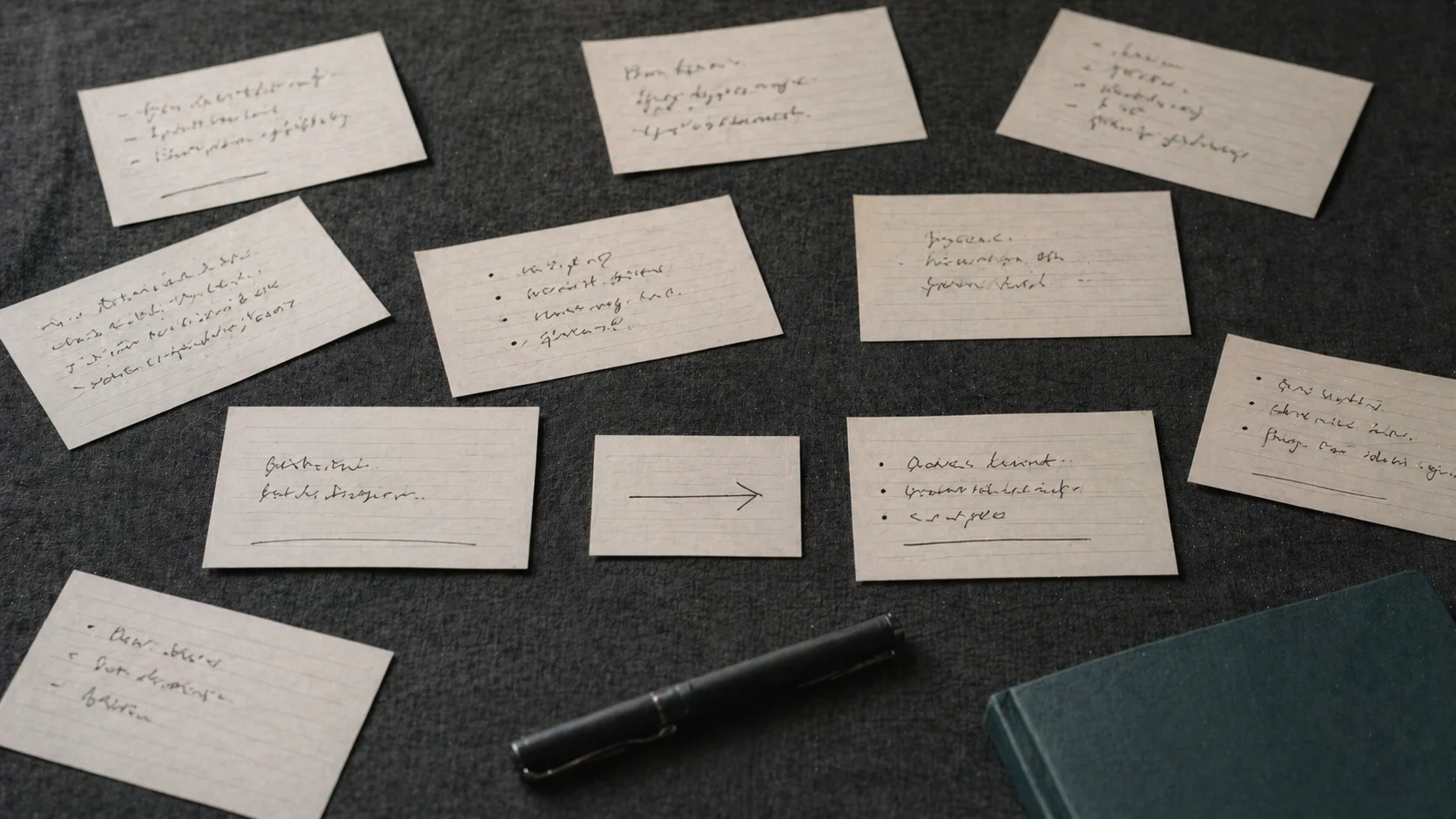
A great deal of advice about “journaling for the ADHD brain” begins with certainty: dump every thought, use an if-then plan, write for five minutes, and your overloaded working memory will quiet down.
Those ideas may be useful. The certainty is the problem.
No large randomised trial has shown that ordinary journaling treats ADHD, and people with the same diagnosis do not share one writing style or one set of difficulties. What we do have is adjacent evidence about multicomponent psychological treatment, working memory, self-monitoring, and implementation intentions. It can inform cautious experiments, but it cannot turn a notebook routine into an evidence-based ADHD intervention.
The useful distinction
- 🧪 Evidence: some clinician-guided ADHD treatments include written tools as one component
- 🚫 Not established: writing is the active ingredient, or a journal reduces ADHD symptoms
- 📝 Practical option: small written formats may help an individual remember, plan, or resume a task
- 🧭 Personal test: change or stop a format that adds friction or distress
- 🩺 Care boundary: a journal does not replace diagnosis, medication review, therapy, coaching, or accommodations
What the treatment research actually shows
Steven Safren and colleagues’ 2010 randomised trial in JAMA compared cognitive behavioural therapy with relaxation plus educational support in 86 medication-treated adults who still had ADHD symptoms. The CBT group had better outcomes on several measures.
That programme included organisation and planning, distraction management, problem-solving, cognitive work, practice between sessions, and clinician support. Calendars, task lists, and written records were part of the package.
The trial did not randomise people to “CBT with writing” versus “the same CBT without writing.” It therefore cannot tell us that the logs caused the improvement, that writing was the active ingredient, or that a person using a journal alone should expect the trial’s response rate.
Written tools can be worth using because they make a plan visible. That practical claim does not require us to mislabel an entire therapy as structured journaling.
Working-memory findings do not explain every blank page
Martinussen and colleagues’ 2005 meta-analysis reported group-level working-memory differences in children with ADHD across multiple studies. It did not test adults free-writing in journals, and it did not show that working memory is the reason an individual loses a thread on the page.
Someone may stall because the topic is too broad, the entry feels like homework, they are tired, the interface is distracting, spelling feels exposed, the emotional material is intense, or the purpose is unclear. ADHD-related executive-function difficulties may be relevant without supplying a single mechanism for everyone.
This matters because the solution changes with the barrier:
| Barrier you notice | A small format to test |
|---|---|
| Too many thoughts compete | Capture them as separate bullets |
| Starting is the obstacle | Pre-write one fixed first line |
| Returning to work is hard | Leave a pointer to the next action and file |
| Long entries feel impossible | Use one sentence or three fields |
| Prompts feel controlling | Remove them and record only what matters |
| The app distracts you | Try paper, a widget, or a single-purpose shortcut |
These are interface adjustments, not treatments.
“Offloading” is a plausible description, not a proven journal mechanism
Writing a reminder means you no longer have to rely only on remembering it. In that ordinary sense, the page is an external record. It does not follow that a brain dump empties working memory, stops thoughts competing for attention, or produces a larger benefit specifically for ADHD.
If you want to try a capture page, keep the claim small:
- Set a short boundary.
- List each task, reminder, or concern on a separate line.
- Do not organise while capturing unless that helps.
- Afterwards, choose whether to transfer actionable items to a task system.
- Close the page even if the list is incomplete.
The result may be useful, neutral, or overwhelming. A personal sense of relief is valid as an experience; it is not proof of a cognitive mechanism or symptom improvement.
If-then plans: a cueing experiment
Implementation intentions pair a cue with an action: If X happens, then I will do Y. A study by Gawrilow and Gollwitzer tested this approach in a specific response-inhibition task involving children with ADHD.
That experiment does not establish “if-then journaling,” nor does performance on one laboratory task prove improvement in daily initiation, organisation, or symptoms. Still, the format can make a plan more concrete:
If I put my coffee down at the desk, then I will open the project file and read the last note.
Use a cue you can observe and an action small enough to begin. If the line is repeatedly ignored, change the environment or the task rather than treating it as a moral failure.
Four low-friction formats to test
1. Capture without organising
Write separate bullets for anything you do not want to keep rehearsing. Stop after a few minutes. Transfer only the items that need to become tasks.
2. A re-entry note
Before leaving a task, write:
- where the work lives;
- the last thing completed;
- the smallest next action;
- anything currently blocking it.
This is a bookmark for future you. Its value is practical and immediately testable.
3. One cue and one action
Write a single if-then line. Avoid a page full of plans, which can create a second task to manage.
4. A three-field check-in
Use stable headings such as:
- What is taking attention?
- What needs to happen next?
- What can wait?
Fixed fields can reduce decisions. If they become stale, replace them; no research makes these exact questions special.
What about emotion-focused writing?
ADHD frequently co-occurs with other mental-health conditions, and emotion-regulation difficulties are reported by many adults. A prevalence estimate from a review does not tell us which journal format is safer or more effective for an individual.
Short and structured writing is not automatically safe; open writing is not automatically risky. Either can become upsetting, repetitive, or invalidating. Consider a lighter topic and a defined endpoint, especially when writing alone:
What am I noticing right now, and what support or next step do I need after closing this page?
Do not start with your deepest traumatic experience because an article says that is the evidence-based method. If writing causes sustained distress, worsens functioning, or raises an immediate safety concern, stop and seek appropriate professional or emergency support.
Our mental-health prompt guide gives more examples while marking the boundary between studied techniques and editorial adaptations.
Making a useful format easier to reopen
The following are design choices, not ADHD treatment principles:
- Keep the entry point visible—a notebook on the desk, a home-screen widget, or a bookmarked file.
- Reduce required fields until the worst day still has a usable version.
- Attach the note to an existing event if reminders help.
- Remove streaks if a missed day makes returning harder.
- Let one line count as a complete entry.
- Keep planning notes separate from emotional writing if the combination feels cluttered.
There is no need to call a gap “data” or insist that every system can be fixed with the right cue. Sometimes a tool simply does not fit. Accessibility needs, medication timing, workload, sleep, support, and the surrounding environment may matter more than the journal.
Paper, app, or both
No study establishes one medium as better for ADHD.
Paper removes app notifications and loads instantly, but can be misplaced, lacks search, and requires physical storage.
An app can provide reminders, search, backup, dictation, widgets, and multiple-device access. It can also add login friction, notifications, and a path to unrelated content.
A hybrid can use paper for immediate capture and a digital system for items that need search, reminders, or backup. The transfer step may help or may become extra work; test it before building a complicated system.
For sensitive entries, choose based on a threat model rather than a “private” label. Check device access, storage provider, E2EE configuration, backups, sharing, and recovery. Our encrypted-journal roundup explains the distinctions.
A one-week experiment
There is no need to adopt three daily sessions for two weeks. Test one format with one observable purpose.
Before work: write the file or page you need to open and the smallest first action.
Before stopping: leave a four-line re-entry note.
At the end of the week, ask:
- Did I reopen the note when I needed it?
- Did it reduce time spent reconstructing where I was?
- Did maintaining it create more work than it saved?
- Would paper, a reminder, a task manager, or an accommodation solve the problem better?
That review tests whether a tool fits your workflow. It does not measure ADHD symptoms or prove a working-memory effect.
Frequently asked questions
Does journaling help with ADHD?
No large randomised trial has established ordinary journaling as an ADHD treatment. Written calendars, task lists, and thought records appear inside some effective multicomponent CBT programmes, but those trials cannot isolate writing as the active ingredient. A journal may still be a practical aid for memory, planning, or reflection.
Why can a blank page feel difficult with ADHD?
ADHD can involve different combinations of attention, working-memory, initiation, and emotion-regulation difficulties, but experiences vary widely. Group-level working-memory findings do not prove why one person stalls. Topic choice, perfectionism, fatigue, access needs, and the tool itself may also matter.
What is an ADHD brain dump?
It is an informal name for quickly listing tasks, worries, reminders, or stray thoughts before organising them. A five- or ten-minute brain dump has not been established as an ADHD intervention or shown to empty working memory. Treat it as a workflow experiment.
Are if-then plans useful for ADHD?
A small experimental literature has tested implementation intentions in specific ADHD tasks. That is not evidence that an if-then line in a journal treats ADHD or improves everyday functioning. It can still be tested as a planning format: name a concrete cue and the smallest action that follows.
Should someone with ADHD use paper or an app?
There is no evidence that one medium works better for ADHD. Paper removes notifications but can be misplaced; an app can offer reminders, search, backup, and accessibility tools but may add distractions or setup. Choose the option with the fewest barriers in your circumstances.
Can journaling make things worse?
Writing can become frustrating, burdensome, or emotionally destabilising for some people, with or without ADHD. Reduce the intensity, switch to practical notes, or stop if distress persists. Journaling should not replace assessment or evidence-based ADHD care.
Further reading
- The 5-Minute Journaling Method — a low-friction editorial routine, not an ADHD treatment
- Journaling Prompts for Mental Health — optional frames with evidence boundaries
- Free Writing vs. Guided Journaling — no universal format winner
- The Best Journaling Apps for Anxiety and Depression — app features without treatment rankings
- Best Encrypted Journaling Apps — storage, E2EE, audit, and recovery trade-offs
- Journaling for Sleep — what one small bedtime-list study can and cannot show