Free Writing vs. Guided Journaling: The Evidence Does Not Pick One Winner
Free writing and guided journaling are broad, overlapping categories. Here is what the research can support—and how to choose without inventing a clinical ranking.
Updated on: June 17, 2026
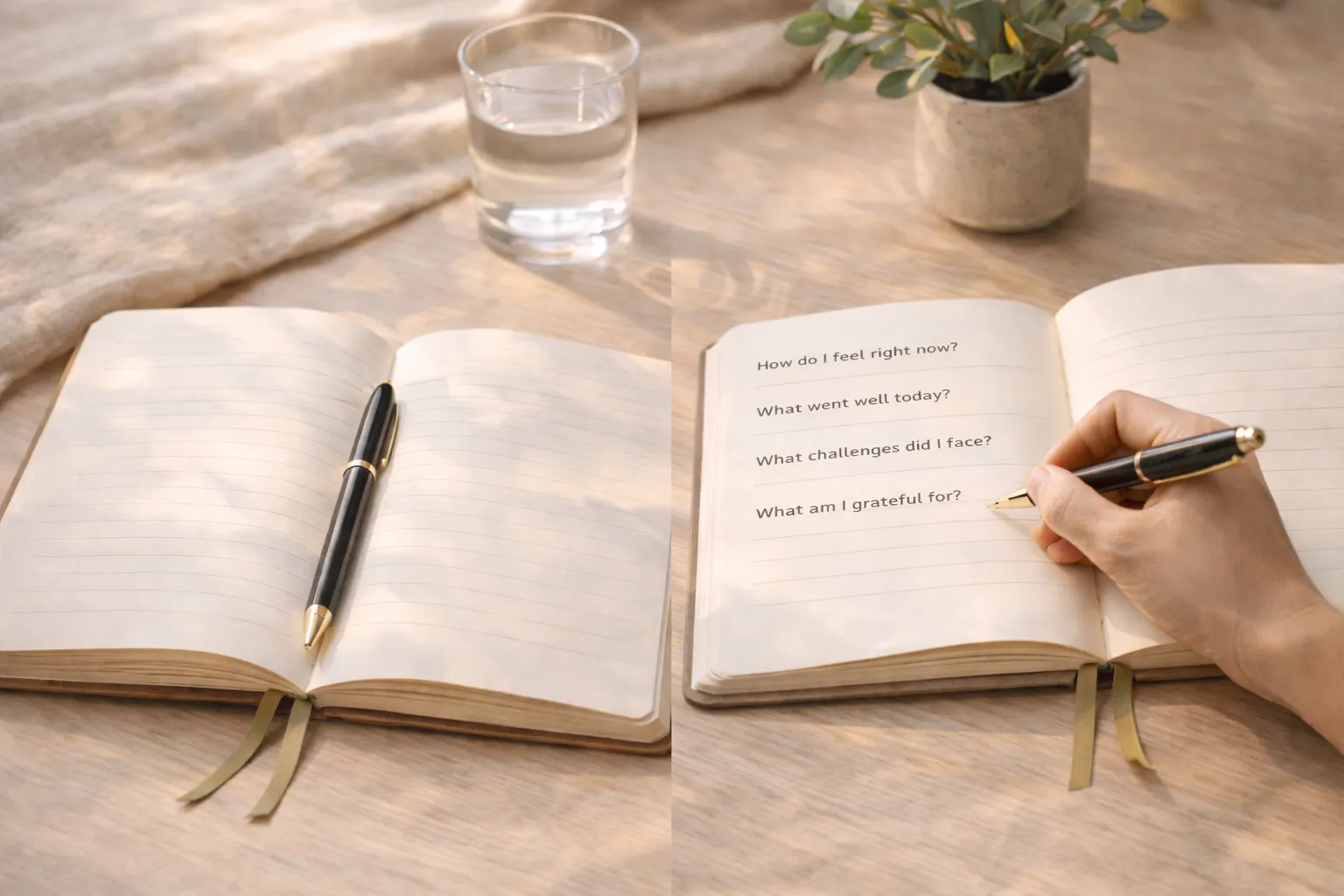
“Free writing” sounds like a blank page with no rules. “Guided journaling” sounds like a workbook that supplies every question. In practice, the boundary is rarely so neat. A person may begin with one prompt, ignore it after three lines, make a list, and end in an open reflection—all in the same entry.
Research is just as untidy. Studies use different topics, time limits, populations, controls, and outcomes. Most do not randomly compare a representative free-writing method with a representative guided method. That means the honest answer is not that one side wins, but that the question is too broad for the evidence offered in its name.
This guide shows how to read that evidence without turning it into a league table, then offers a practical way to choose the amount of structure you need today.
First, define what is actually being compared
The following activities may all appear under “journaling,” but they are not interchangeable:
- writing whatever comes to mind with no topic;
- recording the day in chronological order;
- responding to one open question;
- completing a gratitude list;
- using a CBT thought record;
- following a therapist-delivered writing treatment;
- taking part in an experimental-disclosure study.
A comparison between two items on that list cannot settle all the others. A clinical treatment with a manual and a therapist is not evidence that a commercial prompt app is effective. A study of a gratitude letter is not evidence for morning affirmations. An expressive-writing protocol is not a test of every blank page.
Pennebaker’s protocol is neither side of the caricature
Classic experimental-disclosure instructions associated with James Pennebaker usually provide a topic and boundary: explore thoughts and feelings related to a stressful experience, often for 15–20 minutes on three or four occasions. Participants have freedom within that frame.
That is more directed than “write absolutely anything,” but less prescriptive than a worksheet with fixed fields. It is best described as a specific research intervention, not as proof for a general philosophy of writing.
Frattaroli’s 2006 meta-analysis pooled 146 randomised experimental-disclosure studies and reported a small positive average effect (r = 0.075) across varied outcomes. It also reported moderators associated with study procedures, including instruction features.
Those moderators compare studies that differed in many ways. They are not the same as randomly assigning people to “specific prompt” versus “blank page” while holding everything else constant. They may guide future experiments; they do not justify the claim that research consistently proves structure superior.
Why “more structure works better” overstates the evidence
There are three recurring errors behind that conclusion.
1. Categories are defined after the fact
One article may call Pennebaker’s instruction free writing because participants choose their words. Another calls it guided because the topic and time are specified. Changing the label changes the apparent winner without changing the study.
2. Different interventions answer different questions
A plan for an ongoing problem, a positive-experience prompt, and trauma-focused writing are not interchangeable levels on one structure scale. If their outcomes differ, the cause might be topic, population, comparison condition, dose, support, or measurement—not simply “more guidance.”
3. Moderator associations are treated as causal trials
When a meta-analysis observes larger effects in studies with a feature, that feature may be entangled with other study differences. It does not prove that adding the feature to an otherwise identical journal would cause a larger effect.
The evidence therefore supports a much narrower statement: instructions may matter, and the useful amount of direction is an empirical question for a defined task and population.
Can emotionally open writing backfire?
It can be unhelpful for some people, but the strongest popular claims again exceed the studies.
Sbarra and colleagues studied adults after marital separation and examined different writing conditions alongside individual differences. A subgroup high in rumination-related characteristics had worse outcomes after a narrative expressive-writing condition. This is important safety evidence, but it was not a universal test of “free writing,” and it does not show that every person who ruminates should avoid all emotional writing.
Other studies compare emotion-focused, cognitive-emotional, narrative, fragmented, or factual instructions. Results from one comparison should not become the rule that “venting makes people ill” or that a coherent story is always protective. The tasks and outcomes need to be named precisely.
What can you do with the uncertainty?
- Do not begin by forcing yourself into the most painful topic.
- Set a boundary and check your state afterwards.
- If writing repeatedly intensifies distress, interferes with daily life, or traps you in the same loop, change the topic or stop.
- Do not treat discomfort as proof that an exercise is working.
- Use professional or emergency support when symptoms persist or safety is at risk.
Our guide to journaling and mental health discusses these limits in more detail.
What specific guided interventions can—and cannot—tell us
Positive Affect Journaling
Smyth and colleagues tested a defined web-based Positive Affect Journaling programme in a medical population with elevated anxiety symptoms. Its design, sample, schedule, comparator, and outcomes belong to that intervention. The trial does not establish that guided journaling is generally best for anxiety, that its effect size applies to an app user, or that positive writing is superior to every open format.
CBT thought records
Thought records are homework tools within cognitive behavioural therapy. Evidence for CBT or homework adherence does not isolate the written grid as an independent treatment, and it does not rank all guided journals above free writing. Someone can still use a thought record as an organising aid; that is different from claiming a clinical effect outside therapy.
Written Exposure Therapy
Written Exposure Therapy is a manualised PTSD treatment delivered within clinical care. Its trials compare treatments, not consumer journaling styles. Presenting WET as evidence that a person should structure a private trauma journal erases therapist involvement, eligibility, safety procedures, and the rest of the treatment context.
Gratitude and commercial templates
The Five Minute Journal combines gratitude, intentions, affirmations, highlights, and self-improvement prompts. The branded product and exact combined routine have not been established in peer-reviewed trials. Research on a separate gratitude list or “three good things” exercise cannot automatically validate the combination, the product, a daily schedule, or a five-minute dose.
The same caution applies to any app that assembles individually research-adjacent ideas and calls the result science-backed.
When a prompt is useful
A prompt earns its place when it solves a practical problem:
- Too many possible topics: “What is taking up the most attention right now?”
- A decision feels tangled: “What is known, assumed, and still unknown?”
- A problem is active: “What is one part I can influence, and what is outside my control?”
- You want a memory: “Which detail from today would I otherwise lose?”
- You want to close the page: “What do I need after writing this?”
These are editorial questions, not validated interventions. Their value is that they reduce friction or create a boundary.
When a blank page is useful
Open writing may suit you when:
- the topic is already clear and a prompt would redirect it;
- you are exploring an idea rather than seeking a health outcome;
- memory, creativity, or self-expression is the purpose;
- fixed templates make your answers feel performed;
- you want to notice what emerges before categorising it.
No clinical claim is needed. Writing can be worthwhile as thought, record, or craft even when it has not been shown to reduce a symptom.
The hybrid is an experiment, not an optimum
If you are unsure, try a light frame with room inside it:
- Choose one purpose for the entry.
- Pick one question—or write a title only.
- Set a manageable stopping point.
- Follow the material wherever it goes; the prompt is not a form to complete.
- End by noting whether the structure helped, constrained, or made no difference.
On another day, change one variable. A personal comparison cannot prove a therapeutic effect, but it can reveal which interface helps you write and which one you avoid.
| Situation | A reasonable format to test | What not to infer |
|---|---|---|
| Blank-page friction | One broad question | That the question treats anxiety |
| Clear idea already present | Open writing | That freedom is clinically superior |
| Active practical problem | Facts, options, next action | That planning resolves the emotion |
| Sensitive emotional material | Bounded, tolerable topic | That distress means progress |
| Habit or memory log | Fixed small fields | That a streak creates a health benefit |
Apps through this lens
Day One starts with an open canvas and makes prompts optional. It fits people who want an archive first and structure only when requested.
Journey offers free entries alongside many guided programmes. Treat those programmes as editorial content unless evidence is supplied for a specific product-level claim.
The Five Minute Journal deliberately fixes the questions and timing. That may reduce decisions, but convenience and clinical validation are different claims.
OwnJournal supports open entries and mood/activity fields while storing entry files in a cloud provider you connect—Google Drive, Dropbox, Nextcloud, or iCloud—rather than an OwnJournal content store. E2EE is optional; Simple mode can leave readable copies with the provider. Any mood-activity correlation is descriptive, not proof that an activity caused a feeling.
CBT-oriented apps may reproduce familiar thought-record forms. Check whether the company is offering a worksheet, a coached programme, or regulated clinical care; those are not equivalent.
For broader product trade-offs, see the best journaling apps in 2026 and our journaling-app privacy guide.
The honest bottom line
The literature does not establish free writing or guided journaling as the universal winner. It studies narrower interventions, often against controls rather than against each other. The two popular categories overlap, and attempts to rank them often mix a therapist-delivered treatment, a commercial workbook, and an ordinary blank page as if “structure” were their only difference.
Choose structure for a practical reason: it helps you begin, organise, or stop. Choose openness for a practical reason: it preserves what you already want to say. If the first choice feels wrong, change it. If writing causes sustained harm, stop.
Tonight’s test can be small: write a title that names what the page is for. Add one question only if you need it. Then give yourself permission to leave the question behind.
Frequently asked questions
Is free writing or guided journaling more effective?
The literature does not provide a clean head-to-head verdict. Both labels cover many activities, and most trials test one defined intervention against a control rather than free versus guided writing. Between-study moderators can suggest hypotheses, but they cannot establish a universal winner.
Can free writing make anxiety or depression worse?
Any emotionally intense writing may feel unhelpful or increase distress for some people. One separation study found worse outcomes in a particular high-rumination subgroup assigned to narrative expressive writing, but that was not a test of all blank-page writing. Monitor your response, reduce intensity or stop if distress persists, and seek appropriate care when needed.
Does the Five Minute Journal have research support?
The branded product and exact combined routine have not been established in peer-reviewed trials. Adjacent gratitude, goal, and reflection exercises have been studied, with mixed and conditional findings. Evidence for separate components does not validate the product, their combination, or a five-minute dose.
What type of journaling is best for anxiety?
No journal format is established as best for anxiety. Trials of specific interventions, including a web-based Positive Affect Journaling programme in a medical sample, cannot rank the broad categories or guarantee an individual benefit. Journaling may be an adjunct; persistent or severe anxiety deserves evidence-based care.
Should beginners use prompts or free-write?
Use the option that removes the current barrier. A prompt can reduce topic choice when the page feels too open; free writing can preserve space when you already know what needs attention. A hybrid is a practical experiment, not a scientifically proven optimum.
What is the Pennebaker expressive-writing method?
Classic studies often ask participants to write about thoughts and feelings connected to a stressful experience for roughly 15–20 minutes on three or four occasions. That is a semi-directed research protocol, not pure free writing, and its small average effects do not validate ordinary journaling as a whole.
Further reading
- Journaling Prompts for Mental Health — editorial prompts with evidence boundaries
- Can Journaling Support Mental Health? — effect sizes, uncertainty, and safety
- The Best Journaling Apps in 2026 — features, pricing, platforms, and storage choices
- Is Your Journal Actually Private? — threat models beyond a privacy label
- The Best Journaling Apps for Anxiety and Depression — app features, not a treatment ranking