Morning Pages: Does Julia Cameron's 3-Page Method Actually Work?
Julia Cameron's morning pages: three handwritten pages every morning. What the practice involves and what the research actually shows.
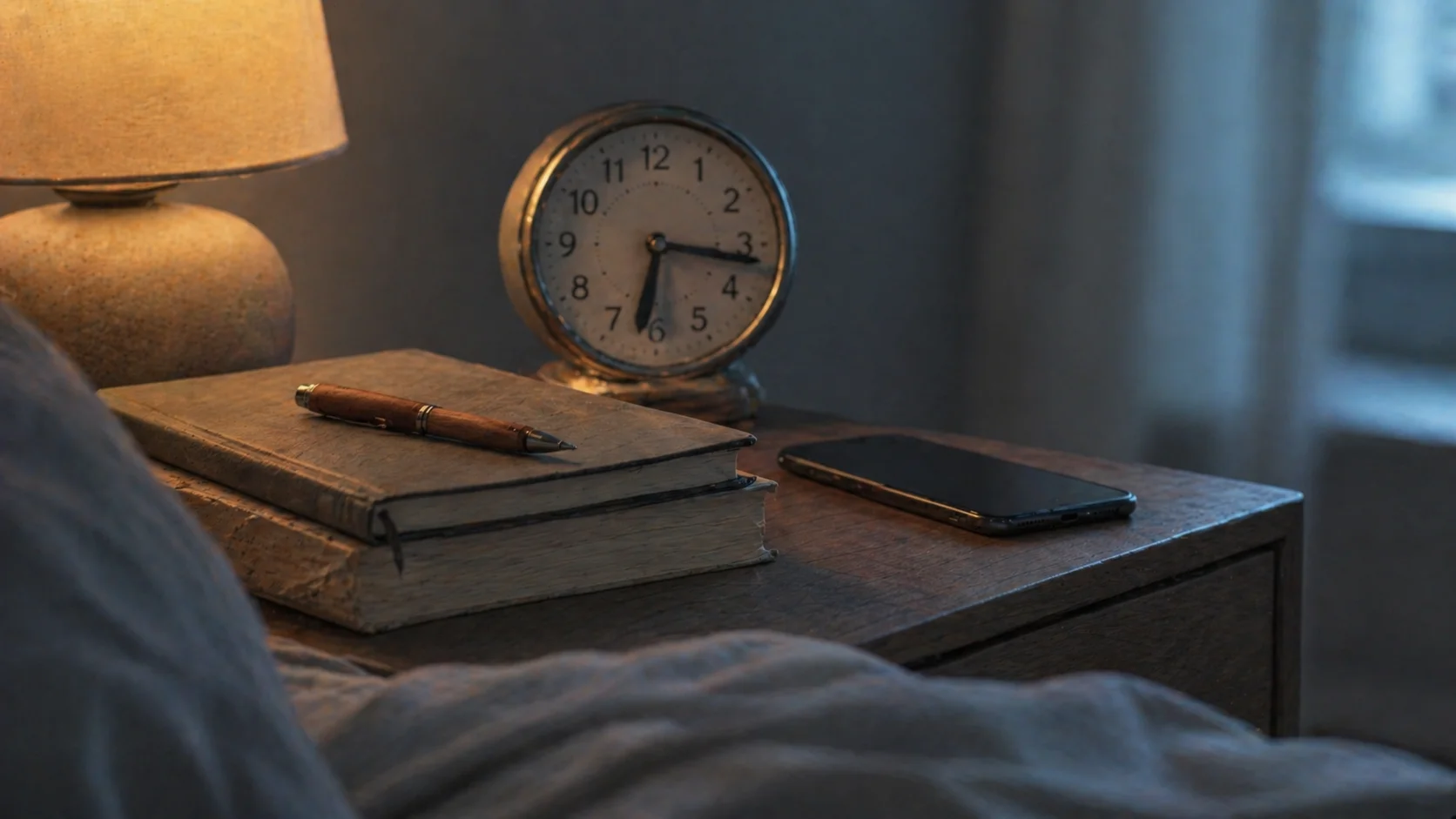
Morning Pages ask for three handwritten pages of stream-of-consciousness writing, every morning, before other input. No peer-reviewed trial has tested that package. Expressive-writing research uses different instructions and cannot verify a general “thoughts out of your head” mechanism for Cameron’s method. The useful question is therefore not whether science has proved Morning Pages, but whether the routine serves your creative or reflective purpose without becoming burdensome.
This guide covers what the practice actually involves, what the research does and does not support, when morning pages can backfire, and how to start a version that fits your life rather than Cameron’s.
What morning pages actually are
Morning pages were introduced by Julia Cameron in her 1992 book The Artist’s Way, a 12-week creative recovery course originally aimed at writers, artists, and creatives feeling blocked. Cameron describes the practice in three strict rules.
Three pages, longhand. The standard is three full pages on letter or A4 paper, written in pen, by hand. Typing does not count for Cameron, and there is no upper limit — you can write more, but never less.
First thing in the morning. Before email, before phone, before reading the news. The goal is to capture the mind in its half-awake state, before the day’s input has narrowed your focus.
No editing, no judgment, no audience. You write whatever surfaces, including grumbling, lists, fragments, complaints, and whatever feels too petty to think. The pages are private. Cameron is explicit that they are not high art, and not even good writing.
That is the entire method. The rest — the proposed creative breakthroughs, the catharsis, the unexpected clarity — Cameron describes as side effects of the discipline, not the goal.
What the research actually says
No peer-reviewed study has tested Morning Pages directly. Adjacent research on expressive writing, free writing, handwriting, and cognitive offloading asks different questions. It can supply context, but it is not indirect validation of Cameron’s package.
The expressive-writing tradition associated with James Pennebaker commonly asks participants to write for 15–20 minutes on three or four occasions about an emotionally significant topic. Morning Pages specify three longhand pages every morning with no required emotional topic. Differences in task, schedule, and outcome prevent a direct inference.
No peer-reviewed study has tested morning pages directly. The supporting evidence comes from adjacent research on expressive writing — which uses shorter sessions, fewer days, and a specific emotional focus.
A study by Klein and Boals (2001) compared defined expressive-writing and comparison tasks in students and measured working-memory outcomes later. It did not test Morning Pages, everyday stream-of-consciousness writing, or a daily three-page routine. Its results do not establish that writing clears intrusive thoughts or frees working memory in this practice.
A 2016 review by Risko and Gilbert discusses cognitive offloading broadly—using external action to alter a task’s information-processing demands. That framework does not show that an unstructured personal journal clears mental clutter or improves creativity.
None of this establishes a Morning Pages benefit, much less that three pages, morning timing, longhand, or consistency is the relevant ingredient.
Why the routine may suit you
Without claiming psychological mechanisms, several practical features may explain why an individual likes the routine.
They remove topic choice. The instruction is simply to keep writing. Some people find that permission easier than selecting a prompt; others find three pages more intimidating than a small question.
They reserve uninterrupted time. The page may function as a protected creative interval. Whether it “clears” anything is a personal description, not a demonstrated cognitive effect.
They impose length. Cameron’s three-page rule can keep someone with a first answer on the page longer. There is no evidence that page two or three reliably reveals a deeper layer; the same rule may produce repetition or fatigue.
A 2018 sleep-lab study by Michael Scullin and colleagues compared a five-minute future-task list with a completed-task list immediately before one laboratory night. It is not evidence for morning stream-of-consciousness writing, “distillation,” or a general externalisation mechanism.
When morning pages can backfire
Any emotionally open writing can feel different across people and circumstances. Morning Pages have not been studied well enough to estimate benefit or harm.
ℹ️ Worth knowing if you tend toward rumination
If free writing repeatedly intensifies distress or locks you into the same loop, change the topic, shorten or stop the session, or seek appropriate support. Research does not establish a structured format as universally safer.
A 2013 study by Sbarra, Boals, Mason, Larson, and Mehl tested narrative expressive writing after marital separation and found worse outcomes in a particular subgroup with rumination-related characteristics. It did not test Morning Pages or blank-page writing in general, so it cannot identify who should avoid this routine.
A 2008 study by Sloan, Marx, Epstein, and Dobbs reported a different pattern in its task and sample. The contrast reinforces that “unstructured writing” is too broad a category for a simple safe/unsafe rule.
Feeling clearer can be a reason to continue as a personal creative practice; it does not prove a therapeutic effect. Feeling persistently more entangled is a reason to pause, change the practice, or seek support—not evidence that discomfort is necessary. Our guide to journaling apps for anxiety and depression compares app features without treating them as treatments.
How to actually do them
If you want to try Cameron’s protocol as written, here is the practical version.
Set up the night before. Put your notebook and pen on the bedside table or kitchen counter — wherever you will sit in the morning. Friction is the enemy of consistency, and a notebook you have to find is a notebook you will not open.
Write before checking your phone if you want to follow the original sequence. Cameron places the pages before other input. Research has not shown that checking a phone changes the value of the practice by loading working memory.
Use materials that do not inhibit you. Some people prefer inexpensive paper; others write more readily in a notebook they enjoy. Price does not determine honesty. Page size and handwriting also make “three pages” an imprecise word count.
Keep moving if you want to follow Cameron’s rule. She suggests writing “I don’t know what to write” when nothing comes. Boredom is permitted by the method, but research has not shown that it unlocks useful material.
Close the notebook when done. Cameron suggests delaying rereading for eight weeks. That is her programme rule, not an evidence-based requirement; choose a safer storage and review policy for your own circumstances.
Common stumbling blocks
Three pages feels impossibly long. It may be, especially at the start. No adherence study tells us how many people quit because of this rule.
A reasonable personal adaptation is to start with one page or a time boundary. There is no evidence-based progression to three pages; expand only if the extra length serves you.
You can’t get up early enough. Cameron is rigid about morning timing; research has not identified “before significant input” as an active ingredient. Choose the time that lets you use the routine without displacing sleep or other needs.
The pages feel boring. They may be boring. Brilliant insights are not required, and “distillation” is not a validated outcome. Continue only if the ordinary pages have value for you; no evidence establishes a useful 30-day pattern.
You start performing for an imagined reader. If an imagined reader changes what you write, reconsider storage or destroy pages when appropriate. No study shows this is the most common failure mode or that an audience breaks a psychological mechanism.
Adapting the method
The three-page longhand morning version is Cameron’s specific method. Adaptations may be more accessible, but there is no established core mechanism to preserve.
Shorter pages. A single page may be easier to begin than three. Research cannot tell us that daily short pages produce more usable insight than sporadic longer ones.
Our 5-minute journaling method covers a structured short-form alternative.
Typed pages. Cameron disagrees, but typing may be more accessible or practical. No study establishes a cognitive-offloading mechanism for Morning Pages or tests whether it depends on handwriting. Brain-activity differences during handwriting do not demonstrate better journaling outcomes. Our comparison of paper journals and apps explores the trade-offs.
Voice memos. Voice notes may be more accessible for some people. Recording or transcription has not been shown to produce the same effect as Morning Pages; treat it as a different personal practice.
Evening pages. A different practice by Cameron’s definition, but not one with a proven different mechanism. The Scullin to-do-list study compared two five-minute list topics before one laboratory night; it does not show that evening stream-of-consciousness pages preserve an offloading benefit or improve sleep.
For a structured comparison of free-form versus prompted writing, see our free writing vs. guided journaling guide.
An optional 7-day trial
If you want to try a smaller version before committing to Cameron’s protocol, the plan below is an editorial usability experiment—not a research-derived progression.
Day 1. One page, longhand or typed, before phone. Set a 10-minute timer. Stop when the timer goes off, even mid-sentence.
Days 2–3. One page, no timer. Whatever comes, however boring.
Days 4–5. Keep one page, or try two if extra length feels useful. There is no evidence that page two is where surface concerns end.
Days 6–7. Three pages, or 30 minutes — whichever comes first. If you reach three pages before the timer, stop; if you reach the timer before three pages, also stop.
Day 8. Decide whether to review, store, or discard the pages. Reviewing may reveal recurring topics or may feel unhelpful; it is not the step that scientifically turns the practice into a tool.
Getting started
If you are curious, a brief trial can show whether the routine fits your life. Feeling clearer may justify keeping it as a creative practice, but does not demonstrate a health effect. Feeling persistently worse is a reason to stop or seek support, not proof that a structured method is necessarily safer.
Tomorrow morning, before you open your phone, write half a page. Not three pages, not even one — just half.
That is the entire commitment. Build from there only if it feels right.
Frequently Asked Questions
Do morning pages actually work?
No peer-reviewed trial has tested Morning Pages as Cameron defines them. Expressive-writing and cognitive-offloading studies use different topics, schedules, and outcomes, so they cannot establish an underlying Morning Pages mechanism or show that consistency matters more than length. The method may still be useful as a creative routine; that is a personal outcome, not a validated health effect.
Do morning pages have to be done by hand?
Longhand is part of Julia Cameron’s original rules, but no study has compared handwritten and typed Morning Pages. Differences in brain activity during handwriting do not demonstrate better creativity or mental-health outcomes for this practice. Type, dictate, or write by hand according to access and preference—while recognising that adaptations are no longer the exact branded method. See our paper vs digital comparison for practical trade-offs.
Can I do morning pages in the evening?
You can write freely in the evening, although Cameron defines Morning Pages as a first-thing practice. No study shows that morning and evening pages target different psychological mechanisms. A 2018 Scullin study compared two short bedtime list topics; it did not test evening stream-of-consciousness pages.
How long do morning pages take?
Most people report 20 to 40 minutes for three full handwritten pages. Cameron is firm about the three-page minimum, but there is no research showing this exact length is required. If three pages is the barrier between starting and not starting, begin with one page and build up.
What if I run out of things to write?
Cameron recommends writing “I don’t know what to write” until another thought appears. You can follow that rule, pause, or end the session. There is no evidence that boredom reliably pushes writers past a surface layer or produces more useful material.
Are morning pages safe for everyone?
Safety depends on the person, topic, and context. A separation study found worse outcomes in a particular subgroup assigned to narrative expressive writing, but it did not test Morning Pages or prove that unstructured writing is generally unsafe and structured writing safer. Stop or change the practice if distress persists, and seek appropriate support when needed.